
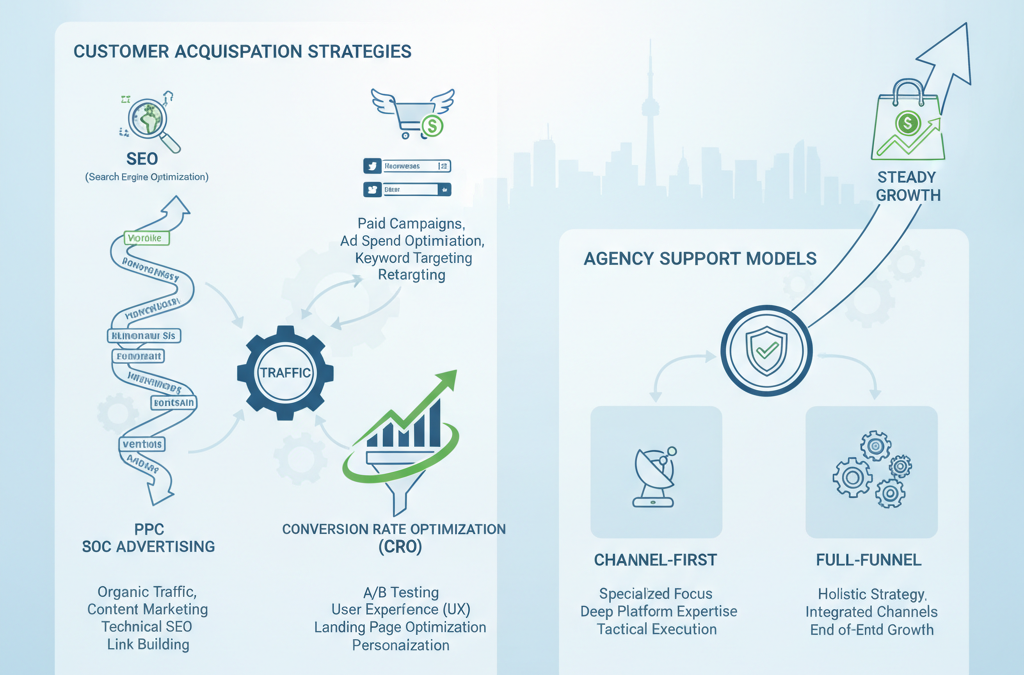
An ecommerce agency can help HVAC businesses turn online interest into measurable sales, booked consultations, product orders, maintenance plan inquiries, and qualified service leads. For HVAC contractors, distributors, and suppliers, ecommerce is not limited to selling products in a cart. It can also include online booking, replacement filter sales, thermostat purchases, parts catalogues, financing inquiries, quote requests, and service-area landing pages that support real revenue.
For a wider digital marketing view, this article on ecommerce agency insights for steady online store growth explains how traffic, conversion, paid media, SEO, and analytics work together. HVAC companies can apply the same principle: more website visitors only matter if the site helps the right customers take the next step.
That is especially important in HVAC, where buyers often compare options, check reviews, research equipment, look for rebates or financing, and decide whether to call, book, or purchase online. A well-structured ecommerce strategy connects search visibility, paid campaigns, website performance, product or service pages, and tracking into one practical growth system.
Why ecommerce strategy matters for HVAC businesses
HVAC websites often serve several audiences at once. A homeowner may need emergency furnace repair. A property manager may be comparing maintenance contracts. A contractor may be looking for parts or supplies. A homeowner planning ahead may be researching heat pumps, air conditioners, indoor air quality products, or smart thermostats.
An ecommerce agency helps organize those different journeys so the website does more than display information. It can help visitors find the right product, request the right service, understand available options, and complete a meaningful action. For some HVAC companies, that action is a direct online purchase. For others, it is a booked estimate, phone call, financing form, or maintenance plan inquiry.
This is where connected Digital Marketing Services can be useful. SEO, paid search, landing pages, tracking, and conversion improvements should not operate as separate projects when the goal is steady HVAC business growth.
What an ecommerce agency can do for an HVAC company
For an HVAC business, an ecommerce agency may work on both marketing channels and website systems. The goal is to improve how customers discover the business, understand its services or products, and take action with less friction.
Common areas of support include:
- Search visibility: Improving service pages, product pages, category pages, technical SEO, internal links, and local search content.
- Paid campaigns: Managing search ads, shopping ads, remarketing, or service-specific campaigns for high-intent HVAC searches.
- Product and service merchandising: Making equipment, filters, thermostats, parts, maintenance plans, and service offers easier to understand and compare.
- Conversion improvements: Reducing friction on quote forms, checkout pages, booking flows, mobile pages, and call-to-action sections.
- Analytics and tracking: Measuring purchases, calls, form submissions, booked appointments, quote requests, and assisted conversions.
The strongest approach usually connects these areas. A paid campaign for furnace replacement can underperform if the landing page is slow, unclear, or missing trust signals. A product catalogue can attract traffic but fail to convert if filters, specifications, shipping details, or compatibility information are hard to use.
How HVAC ecommerce differs from standard retail ecommerce
HVAC ecommerce often combines product sales, technical education, and service-based decision-making. Unlike a simple retail store, an HVAC site may need to support urgent needs, planned replacements, commercial inquiries, and product research at the same time.
That changes how an ecommerce agency should think about strategy. The website should not only push products. It should help users understand whether they need repair, replacement, maintenance, installation, or a specific part. In some cases, the best conversion is not an immediate sale but a qualified request that allows the HVAC company to recommend the right solution.
Examples of HVAC ecommerce pathways
- Direct product purchase: Replacement filters, smart thermostats, humidifier pads, accessories, or indoor air quality products.
- Quote-based sales: Furnaces, air conditioners, heat pumps, boilers, ductless systems, or commercial HVAC equipment.
- Service booking: Maintenance visits, inspections, repairs, tune-ups, or seasonal system checks.
- Lead generation: Installation consultations, financing inquiries, rebate-related questions, or commercial service requests.
- Local discovery: Service-area searches, emergency HVAC queries, and location-specific repair or installation pages.
Key areas an ecommerce agency should review on an HVAC website
Before scaling traffic, an agency should understand where the current website is helping or hurting performance. HVAC buyers often need reassurance before taking action, so clarity and usability matter as much as traffic volume.
1. Service and product page quality
Each important HVAC service or product category should have a clear page with useful information. Visitors should quickly understand what is being offered, who it is for, what the next step is, and how to contact or purchase.
For product-focused pages, useful details may include specifications, compatibility, available options, shipping or pickup information, and installation considerations. For service-focused pages, useful details may include service area, request process, system types, and clear calls to action.
2. Mobile experience
Many HVAC searches happen on mobile devices, especially urgent repair searches. If the website is slow, difficult to navigate, or hard to call from, marketing spend can be wasted. Mobile-friendly layouts, visible phone numbers, simple forms, and fast-loading pages are important.
3. Local and organic SEO structure
HVAC businesses often depend on local visibility. An ecommerce agency should review whether the site has strong service pages, location pages where appropriate, product categories, internal linking, page titles, schema considerations, and content that matches search intent.
When organic visibility is a priority, SEO Services can help align technical structure, content, and local search signals with the way HVAC customers actually search.
4. Paid search and campaign alignment
HVAC paid campaigns can become inefficient if ads send users to generic pages or if tracking does not separate calls, quote forms, product purchases, and low-quality inquiries. Strong Google Ads Management should match each campaign to the right landing page and conversion action.
5. Tracking and reporting
HVAC companies need to know which channels are producing useful actions. A report that only shows clicks and impressions is not enough. The business should understand which campaigns are leading to booked calls, form submissions, online orders, estimate requests, and meaningful service opportunities.
SEO vs PPC for HVAC ecommerce growth
SEO and PPC both have a place in HVAC ecommerce and lead generation, but they serve different roles. SEO is useful for building long-term visibility around services, product categories, maintenance questions, and local search intent. PPC is useful when a company needs faster visibility for urgent searches, seasonal campaigns, promotions, or competitive service categories.
An ecommerce agency should help decide how each channel fits the current situation instead of treating one channel as the answer to every problem.
Step 1: Identify the highest-value customer actions
Before choosing SEO or PPC priorities, define which actions matter most. For an HVAC contractor, that may be booked installation estimates. For a supplier, it may be product purchases or account inquiries. For a hybrid business, it may be a mix of calls, forms, and online sales.
Step 2: Review current search demand
Some HVAC topics have strong ongoing search demand, such as furnace repair, AC installation, heat pump information, filter replacement, or thermostat troubleshooting. SEO can help build durable visibility for those searches, while PPC can fill gaps where the company needs immediate exposure.
Step 3: Match landing pages to intent
A person searching for emergency repair should not land on a broad homepage if a dedicated repair page would answer the need more clearly. A person shopping for replacement filters should not have to search through unrelated service pages. Intent alignment improves both organic and paid performance.
Step 4: Use paid campaigns to test demand
PPC can help test which services, products, offers, or locations generate meaningful interest. Those insights can then inform SEO content, product category improvements, and landing page updates.
Step 5: Build reporting across channels
SEO and PPC should not be reviewed in isolation. A customer may click an ad, return later through organic search, and then call. Reporting should make those journeys easier to understand so budget decisions are based on useful data.
How to choose the right ecommerce agency for an HVAC business
The right ecommerce agency should understand that HVAC growth is not only about increasing traffic. It is about improving the path from search to sale, call, quote, or booking. That requires a practical understanding of customer intent, service-area visibility, paid search economics, website usability, and tracking.
When comparing support, HVAC businesses should ask questions such as:
- Can the agency support both product sales and service leads? HVAC websites often need both.
- Will they review landing pages before increasing ad spend? More traffic does not fix a weak page.
- Do they understand local search? HVAC customers often search by city, neighbourhood, service area, or urgency.
- Can they track calls, forms, purchases, and bookings? HVAC conversions are not always simple checkout events.
- Do they explain trade-offs clearly? The agency should be able to explain when SEO, PPC, website updates, or tracking improvements should come first.
Conversion improvements that matter on HVAC websites
HVAC buyers often need confidence before they act. A site that looks polished but does not answer practical questions may still lose potential customers. Conversion improvements should focus on clarity, speed, trust, and ease of action.
Useful areas to review include:
- Clear calls to action: Buttons for calling, booking, requesting a quote, buying a product, or asking a question should be easy to find.
- Service-specific pages: Furnace repair, AC installation, heat pump service, ductless systems, indoor air quality, and maintenance should not all rely on one generic page.
- Product organization: Filters, thermostats, parts, and accessories should be categorized in a way that matches how customers shop.
- Trust signals: Licensing information, service process, warranties, reviews, financing details, and support information can reduce hesitation where appropriate.
- Fast contact options: Phone links, short forms, booking tools, and clear service-area details help users take action quickly.
- Helpful content: FAQs, buying guides, maintenance explanations, and comparison pages can support customers who are still researching.
What impacts ROI for HVAC ecommerce and digital campaigns
Return on investment depends on more than ad budget. HVAC marketing performance is shaped by search intent, service availability, website speed, page relevance, offer clarity, tracking quality, and how well the sales or service team handles incoming inquiries.
For example, a campaign may generate many clicks for a broad HVAC term but produce few qualified leads if the landing page is too general. A product page may attract visitors but fail to sell if compatibility details are unclear. A service page may rank well but fail to generate calls if the phone number is difficult to find on mobile.
An ecommerce agency should look at these connected factors before recommending bigger budgets. The goal is not louder marketing; it is better alignment between customer intent and the next action.
Signs an ecommerce agency is thinking clearly about HVAC growth
A thoughtful agency will ask about more than rankings and clicks. It will want to understand service areas, equipment categories, seasonality, product margins, booking processes, call handling, and which customer actions are most valuable.
Positive signs include:
- They review both SEO and PPC opportunities before choosing a channel priority.
- They ask whether the website can convert more traffic before increasing spend.
- They separate product purchases, quote requests, calls, and service bookings in reporting.
- They consider local visibility and ecommerce usability together.
- They can explain what should be fixed first and why.
FAQs About Ecommerce Agency Support for HVAC Companies
Can an ecommerce agency help an HVAC company that does not sell products online?
Yes. Ecommerce strategy can still apply when the main conversion is a quote request, booked service, phone call, maintenance plan inquiry, or consultation. The focus is on improving the digital path from search to action.
Is SEO important for HVAC ecommerce?
Yes. SEO can support visibility for services, products, equipment categories, maintenance questions, and local searches. It is especially useful for building long-term discovery beyond paid campaigns.
Should an HVAC business use PPC or SEO first?
It depends on timing and website readiness. PPC can create faster visibility for urgent or seasonal searches. SEO is better for long-term organic visibility. Many HVAC businesses use both, with PPC supporting immediate demand while SEO builds durable reach.
What should HVAC companies track on their websites?
Important actions may include phone calls, quote forms, booked appointments, product purchases, financing inquiries, contact forms, and service-area page engagement. Tracking should reflect how the business actually earns revenue.
How can an ecommerce agency improve HVAC product pages?
It can improve product organization, technical SEO, descriptions, compatibility details, calls to action, checkout usability, internal linking, and measurement. The aim is to help customers find the right product and complete the next step with less confusion.
Steady HVAC growth comes from a connected digital system
For HVAC companies, an ecommerce agency is most useful when it connects visibility, website usability, paid campaigns, product or service clarity, and measurement. More traffic alone is rarely the full answer. The better question is whether the website and campaigns are helping the right customers take the right action.
If your HVAC business is trying to improve online sales, quote requests, service bookings, or campaign performance, a structured review can help identify the next practical step. For digital strategy questions, you can 📩 ask an SEO/PPC question.
Related Topics:
- HVAC digital marketing
- ecommerce agency strategy
- HVAC SEO
- Google Ads for HVAC companies
- conversion optimization
- analytics and tracking setup


