
Why marketing B2B matters for commercial HVAC companies
Marketing B2B for HVAC is the process of attracting, educating, and converting business buyers who need heating, cooling, ventilation, building automation, maintenance, retrofit, or emergency service support. Unlike residential HVAC marketing, commercial HVAC sales often involve longer timelines, multiple stakeholders, building-specific requirements, and higher-value decisions. A property manager, facility director, general contractor, building owner, or operations lead may all influence the final choice.
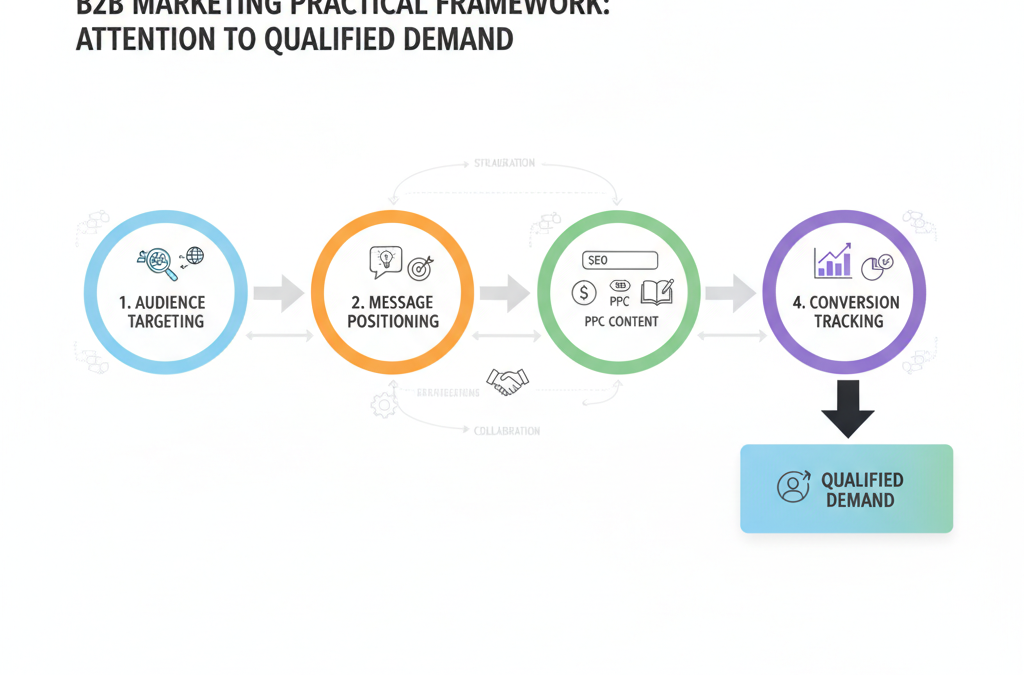
That is why commercial HVAC companies need more than visibility. They need a system that turns attention into qualified demand. The broader principles behind marketing B2B that turns attention into qualified demand apply especially well to HVAC contractors because buyers are not just looking for a vendor; they are looking for reliability, response capability, technical confidence, and lower operational risk.
For an HVAC company, the challenge is rarely just getting clicks. The real challenge is reaching the right commercial accounts at the right time with the right message. A campaign may generate traffic, but if the landing page does not explain service areas, commercial capabilities, maintenance programs, emergency response, or project experience, the visitor may leave without contacting sales. Strong Digital Marketing Services help connect marketing activity to buyer readiness, lead quality, and measurable growth.
How B2B HVAC marketing works in practice
In practice, B2B HVAC marketing connects four important pieces: audience targeting, service positioning, demand capture, and conversion tracking. Audience targeting defines who the company wants to reach, such as property managers, facility managers, industrial operators, commercial landlords, institutional buyers, builders, or franchise owners. Service positioning explains why the HVAC company is the right fit for that buyer’s building, budget, compliance needs, and response expectations.
Demand capture happens through search, paid ads, content, local visibility, email, and service-specific landing pages. Conversion tracking shows which channels are producing real commercial enquiries instead of low-fit requests. This is where SEO Services, paid search, website improvements, landing pages, and analytics need to work together rather than operate as disconnected tasks.
Commercial HVAC buyers usually want clear answers before they contact a contractor. They may want to know whether the company handles rooftop units, chillers, boilers, make-up air systems, building automation, preventative maintenance, retrofits, emergency repairs, or multi-site service. If that information is buried or vague, even strong traffic can fail to become qualified enquiries.
The HVAC buyers your marketing must speak to
A commercial HVAC sale is rarely decided by one person. Different stakeholders care about different outcomes. A building owner may focus on asset value and operating costs. A facility manager may care about uptime, response speed, and maintenance planning. A property manager may want fewer tenant complaints and reliable vendor communication. A finance approver may need budget clarity and risk reduction.
This matters because generic HVAC marketing often speaks too broadly. “Reliable HVAC service” is useful, but it may not be specific enough for a buyer comparing commercial contractors. Stronger B2B messaging connects services to real business concerns, such as reducing downtime, planning seasonal maintenance, supporting tenant comfort, meeting project timelines, or managing HVAC needs across multiple properties.
When the message matches the buyer, the marketing becomes more useful. Instead of asking every visitor to call immediately, the website can guide different audiences toward maintenance agreements, emergency service, retrofit consultations, commercial installation, or building-specific assessments.
Channels that often matter most for B2B HVAC demand
Commercial HVAC companies usually benefit from a mix of channels because buyers discover and evaluate providers in different ways. A facility manager may search for a specific service. A property manager may compare local companies. A building owner may read educational content before planning a replacement. A contractor may look for a mechanical partner for an upcoming project.
High-intent search is especially important when buyers already know what they need, such as commercial HVAC repair, rooftop unit maintenance, chiller service, boiler replacement, or HVAC maintenance contracts. Paid search can help capture urgent or competitive demand faster. Organic SEO supports long-term visibility for service, location, and problem-based searches. Content helps educate buyers who are not ready to request a quote yet but are actively researching options.
Local search can also be important for HVAC companies because buyers often prefer contractors that can respond in their service area. Google Business Profile visibility, accurate service pages, and location-relevant content can support commercial enquiries, especially when paired with a clear website experience.
A practical B2B marketing framework for HVAC companies
Step 1: Define the commercial buyer groups
Before investing in campaigns, an HVAC company should define the types of organizations it wants to attract. Commercial office buildings, retail plazas, industrial facilities, property management firms, schools, healthcare buildings, restaurants, and multi-location businesses may all have different needs.
What to document: Buyer roles, building types, common HVAC problems, urgency triggers, contract expectations, and decision criteria.
Real consequence: More relevant messaging and fewer enquiries from buyers who are not a fit for the company’s capabilities.
Example: A property management company evaluating preventative maintenance will need different information than a general contractor looking for HVAC support on a new build.
Step 2: Match each service page to buyer intent
Not every visitor is looking for the same solution. Someone searching for emergency commercial HVAC repair is likely much closer to contacting a contractor than someone researching the benefits of preventative maintenance. The website should reflect those differences.
What to build: Dedicated pages for commercial HVAC repair, maintenance agreements, installation, replacement, retrofits, rooftop units, boilers, chillers, ventilation, controls, and service areas where relevant.
Real consequence: Visitors find answers faster, and the company can route enquiries toward the right service path.
Example: A search for commercial rooftop unit repair should not land on a generic homepage that only says “heating and cooling services.”
Step 3: Build tracking before increasing ad spend
HVAC marketing can appear successful on the surface while still producing weak sales outcomes. Clicks, impressions, and form fills do not always mean qualified commercial opportunities. Tracking should show which campaigns lead to phone calls, form submissions, booked appointments, maintenance enquiries, and sales-qualified opportunities.
What to track: Service-specific form fills, phone calls, booked consultations, emergency service requests, maintenance contract enquiries, and CRM outcomes where possible.
Real consequence: Better budget decisions and less reliance on vanity metrics.
Example: A paid search campaign may generate fewer leads than another campaign but produce more valuable commercial maintenance opportunities.
Step 4: Improve the conversion path
Commercial HVAC prospects often leave a website when they cannot quickly confirm whether the contractor serves their building type, area, or equipment category. The conversion path should reduce uncertainty and make the next step obvious.
What to improve: Headlines, service descriptions, trust signals, commercial experience, service area clarity, contact forms, phone visibility, FAQs, and page speed.
Real consequence: Better enquiry quality without relying only on more traffic or higher ad budgets.
Example: A maintenance agreement page should explain who the service is for, what types of systems are supported, how inspections are scheduled, and how a buyer can request a conversation.
Step 5: Review marketing and sales together
B2B HVAC marketing should not be reviewed only inside an advertising dashboard. Sales feedback matters because it reveals whether leads are real opportunities, whether prospects understand the offer, and whether certain services or locations are attracting better-fit buyers.
What to review monthly: Lead source, service requested, building type, sales notes, lead quality, close status, and common objections.
Real consequence: A stronger acquisition system that improves based on actual business outcomes.
Example: If many enquiries are for residential repairs but the company wants commercial contracts, the targeting, keywords, and landing pages may need to be tightened.
What HVAC companies should look for in a marketing partner
Choosing a marketing partner for a commercial HVAC company is not only about who can run ads or write blog posts. The right team should understand how to connect traffic, service pages, call tracking, lead quality, and sales feedback. If reporting focuses only on impressions and clicks, it may not show whether marketing is helping the business win better commercial opportunities.
A useful question is: can the agency explain what happens after the click? For HVAC companies, that means understanding whether the visitor called, submitted a form, requested emergency support, asked about maintenance, or turned into a qualified sales conversation. A capable digital partner should be able to support strategy, implementation, tracking, and conversion improvement.
- Channel fit: Ask whether SEO, paid search, content, remarketing, and local visibility match the HVAC company’s service mix and sales cycle.
- Measurement maturity: Confirm how calls, forms, GA4 events, CRM data, and lead quality are tracked.
- Service page strategy: Make sure the agency can build or improve pages for commercial HVAC services, not just send traffic to a homepage.
- Lead quality focus: Ask what they would change if campaigns generated enquiries but few qualified commercial opportunities.
What affects ROI in B2B HVAC marketing
ROI in commercial HVAC marketing is shaped by more than the advertising channel. It depends on targeting, service-market fit, website clarity, follow-up speed, tracking quality, and sales process. Two HVAC companies can spend similar amounts on marketing and see different outcomes because one has clearer positioning, better landing pages, and stronger lead qualification.
A helpful way to think about it is this: traffic is only the starting point. If a prospect lands on a page that does not explain commercial capabilities, response expectations, service areas, or next steps, the campaign may underperform even if the audience is relevant. In many cases, improving the website and follow-up process can be as important as increasing the media budget.
Several factors often influence ROI:
- Search intent: Service-specific commercial searches often indicate stronger buying intent than broad educational searches.
- Landing page relevance: Pages focused on one service or buyer type usually create less friction than broad pages.
- Tracking quality: Call tracking, form tracking, and analytics help identify which campaigns produce real opportunities.
- Response process: Commercial buyers often compare multiple contractors, so timely follow-up matters.
- Offer clarity: Buyers respond better when they understand what service is provided, who it is for, and how to take the next step.
SEO vs PPC for commercial HVAC companies
SEO and PPC are often treated as separate options, but for B2B HVAC marketing they usually work best together. SEO helps build long-term visibility for commercial HVAC services, maintenance topics, equipment-specific searches, and local service areas. PPC can generate faster visibility for high-intent terms and urgent service needs while organic rankings are still developing.
If an HVAC company needs immediate lead flow, paid search can provide quicker market feedback. If the company wants a more durable source of non-paid visibility, SEO is important over time. The most balanced approach often uses PPC to capture existing demand and SEO to build authority around service categories, locations, and educational topics.
- Use SEO when: You want long-term visibility for commercial HVAC services, maintenance planning, equipment information, and local searches.
- Use PPC when: You need faster visibility for urgent or high-value searches such as emergency commercial HVAC repair or maintenance contracts.
- Use both when: You want short-term enquiry generation and long-term demand capture working together.
How local HVAC companies can compete for commercial buyers
Local competition in HVAC can be dense, but not every contractor communicates clearly to commercial buyers. Some companies focus heavily on residential service. Others mention commercial work but do not explain their capabilities in enough detail. This creates an opportunity for HVAC businesses that can clearly position their commercial services online.
For local B2B HVAC growth, relevance matters. Buyers often want a contractor that understands their region, service area, building types, seasonal demand, and response expectations. Clear location pages, commercial service pages, Google Business Profile optimization, and consistent contact information can all support trust.
- Own a clear niche: Commercial maintenance, rooftop units, industrial HVAC, multi-site service, or building automation can each support more focused positioning.
- Strengthen the basics: Fast pages, clear calls to action, accurate service areas, and trust signals often outperform vague messaging.
- Answer buyer questions: Content should help facility managers and property owners understand service options before they contact sales.
- Use regional intent: Build pages around how local commercial buyers actually search for HVAC support.
Common B2B HVAC marketing mistakes
- Using residential messaging for commercial buyers. Commercial prospects need details about building types, equipment, response capability, contracts, and maintenance planning.
- Sending all traffic to the homepage. Service-specific searches should lead to service-specific pages whenever possible.
- Tracking leads without qualifying them. A form fill is not automatically a good opportunity. Lead source and sales feedback are needed.
- Ignoring phone calls. Many HVAC enquiries happen by phone, especially urgent service requests, so call tracking matters.
- Writing content without a conversion path. Educational articles should guide readers toward relevant services, not leave them at a dead end.
Key takeaways for B2B HVAC marketing
Strong B2B HVAC marketing is not about chasing every channel. It is about building a system that helps the right commercial buyers find, understand, and trust your company. Clear service positioning, intent-matched pages, reliable tracking, and consistent follow-up can make marketing more useful to both sales teams and buyers.
For HVAC companies that want better commercial demand, the practical question is not whether SEO, PPC, content, or local search sounds impressive. The question is whether each tactic supports qualified enquiries, reflects how commercial buyers make decisions, and can be measured honestly. For tailored digital marketing guidance, you can 📩 Ask an SEO/PPC question.
FAQs About B2B HVAC Marketing
How is B2B HVAC marketing different from residential HVAC marketing?
B2B HVAC marketing usually targets property managers, facility teams, building owners, contractors, and business operators. It often involves longer sales cycles, higher-value decisions, multiple stakeholders, and more emphasis on reliability, maintenance planning, equipment expertise, and service response.
Which marketing channel should a commercial HVAC company start with?
The best starting point depends on goals and timing. Paid search can help capture immediate demand, while SEO supports long-term visibility. Many commercial HVAC companies benefit from a phased mix that includes service page improvements, tracking, SEO, and paid campaigns.
What should a commercial HVAC landing page include?
A strong landing page should include the specific service offered, the types of buildings or systems supported, service area information, trust signals, a clear call to action, phone and form options, and answers to common buyer questions.
How can HVAC companies improve lead quality?
Lead quality usually improves when targeting, keywords, service pages, forms, and qualification criteria are aligned. Commercial-focused messaging also helps reduce low-fit residential enquiries when the company is trying to grow B2B opportunities.
Why does tracking matter for HVAC marketing?
Tracking helps show which campaigns generate calls, forms, booked appointments, and qualified opportunities. Without tracking, an HVAC company may spend budget on channels that look active but do not produce meaningful commercial demand.


