
For HVAC contractors, the phrase best GPT ads agency for advertising on OpenAI ChatGPT should not mean chasing an AI trend for its own sake. It should mean finding a marketing partner that understands how homeowners and property managers search for urgent, seasonal, and high-intent HVAC solutions—then connects that demand to measurable calls, bookings, form submissions, and service revenue.
If your heating and cooling business is evaluating AI-driven ad opportunities, this guide to choosing a GPT ads agency for advertising on OpenAI ChatGPT explains the broader agency-selection framework. For an HVAC company, the same idea applies with a more local and service-based lens: the agency should know how to manage urgent intent, geographic targeting, landing pages, tracking, and lead quality before recommending any emerging ad channel.
The right GPT ads agency for an HVAC business should already be strong in the fundamentals that make Digital Marketing Services work across search, paid media, content, and conversion optimization. AI advertising may change the environment where a prospect asks questions, but it does not remove the need for clear offers, clean data, fast pages, and a reliable follow-up process.
What a GPT ads agency means for an HVAC company
A GPT ads agency should help your HVAC business understand how conversational discovery may influence customer decisions. A homeowner using a traditional search engine might type “AC repair near me” or “furnace installation cost.” In a conversational AI tool, that same person may ask a longer question such as how to compare repair versus replacement, what to do when an air conditioner stops cooling, or how to find a reliable contractor for emergency service.
That difference matters. HVAC advertising is often driven by urgency, location, seasonality, trust, and service clarity. A capable agency should be able to translate those customer conversations into campaign strategy, landing page content, lead tracking, and follow-up workflows. If the agency already manages Google Ads Management, it should be able to explain what would stay consistent in GPT-style advertising and what may change as AI ad formats mature.
The strongest agencies will also understand organic visibility. HVAC companies that invest in SEO Services, local service pages, technical website health, and helpful content are usually better prepared for both search visibility and AI-influenced discovery. Paid exposure can create attention, but your website, offer, and tracking determine whether that attention becomes a booked job.
How to evaluate the best GPT ads agency for HVAC marketing
Before hiring an agency for GPT advertising, an HVAC contractor should look for operational discipline rather than AI buzzwords. Ask how the agency researches demand, separates emergency leads from research-stage prospects, builds landing pages, tracks phone calls, and reports on qualified leads. A useful agency will talk about booked appointments and lead quality, not just impressions or traffic.
This is especially important for HVAC lead generation ads. A campaign may appear successful if it drives clicks, but if the calls are outside your service area, the forms are incomplete, or the landing page does not match the customer’s need, the spend can become wasteful. A strong agency should connect media buying, conversion rate optimization, analytics, content, and local intent into one system.
Ask direct questions before signing: Who owns the tracking setup? How are phone calls attributed? Can the agency separate installation leads from repair leads? How are emergency requests handled? Are campaigns segmented by service area, season, and service type? These practical questions reveal whether the agency understands HVAC marketing or is simply adding “AI” to a standard pitch.
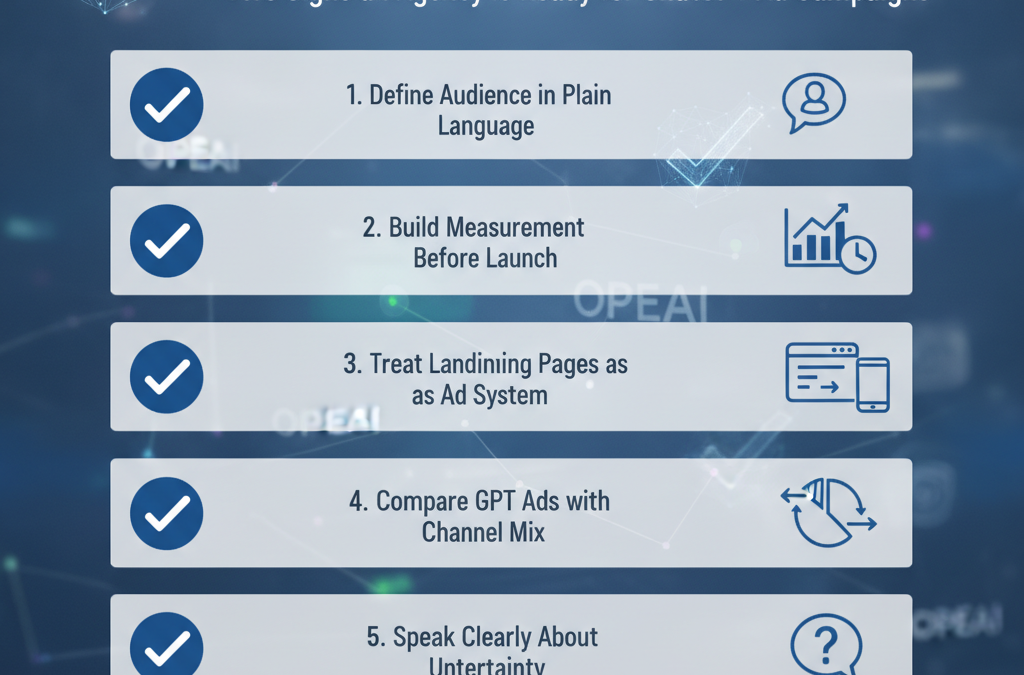
Five signs an agency is ready to manage GPT ad campaigns for HVAC
Step 1: They understand HVAC customer intent
A capable agency should know the difference between someone comparing heat pump options, someone pricing a furnace replacement, and someone needing emergency AC repair. These are not the same lead types, and they should not always receive the same message.
What to look for: Clear segmentation by service type, urgency, and customer stage.
Why it counts: Conversational platforms may reveal more detail about the customer’s situation than a short search query.
Example: A homeowner asking whether to repair or replace an old furnace may need an educational landing page, while someone searching for no-heat emergency service needs a fast call option.
Step 2: They build tracking before campaign launch
HVAC advertising depends heavily on calls, forms, booked appointments, and sometimes offline sales outcomes. The agency should map these conversions before any new campaign starts, so performance can be judged by business value rather than surface-level activity.
What to look for: A plan for conversion tracking, call tracking, analytics, and source attribution.
Why it counts: Without clean tracking, it is difficult to know whether GPT-style ads are producing real service opportunities.
Example: If an installation lead becomes a booked consultation but is not connected back to the campaign source, budget decisions become unreliable.
Step 3: They treat landing pages as part of the ad system
For HVAC companies, the post-click experience matters as much as the ad. A landing page should match the customer’s need, show the relevant service, make the next step obvious, and reduce friction for calling or booking.
What to look for: Experience with landing pages and conversion rate optimization.
Why it counts: A homeowner with an urgent heating or cooling issue will not wait for a confusing page to explain itself.
Example: A page for “emergency furnace repair” should not send users to a generic homepage where they must search for contact details.
Step 4: They compare GPT ads with your existing HVAC channels
A serious agency should not recommend GPT advertising in isolation. It should compare the opportunity against paid search, local SEO, retargeting, seasonal campaigns, and existing lead sources.
What to look for: Cross-channel planning across search engine marketing, paid social, local SEO, and content.
Why it counts: HVAC budgets are often seasonal, so new testing should not weaken channels that already generate reliable calls.
Example: During peak AC repair season, paid search may remain the strongest demand-capture channel, while GPT-focused testing may support education, comparison, or mid-funnel discovery.
Step 5: They are honest about uncertainty
Any agency discussing emerging AI ad formats should be clear about what is known, what is still developing, and what needs to be tested. Overconfident guarantees are a warning sign, especially in a newer advertising environment.
What to look for: Practical testing plans, cautious budget recommendations, and reporting tied to outcomes.
Why it counts: HVAC contractors need predictable lead flow, not vague promises about future platforms.
Example: An agency that recommends a small, measurable test before scaling is usually safer than one promising volume without data.
Where GPT advertising fits in an HVAC marketing strategy
GPT advertising should be viewed as a potential addition to an HVAC marketing system, not a replacement for proven channels. Most heating and cooling companies still need strong local search visibility, well-managed paid search, a properly optimized website, and a clear process for handling calls and form submissions.
For many contractors, the best first step is strengthening the foundation: service-area pages, repair and installation pages, emergency service messaging, call tracking, form tracking, and campaign reporting. Once those pieces are reliable, testing new AI-driven ad opportunities becomes more useful because the business can compare performance against existing channels.
This is where full-service marketing support can help. If an agency understands Website Design & Development, paid media, SEO, analytics, and conversion optimization, it can improve the full customer journey instead of blaming results on a single platform.
SEO vs PPC vs GPT ads for HVAC companies
Search engine optimization, PPC, and GPT advertising each play a different role in HVAC growth. SEO helps build long-term visibility for service pages, local searches, educational content, and technical website quality. PPC helps capture immediate demand from people actively searching for repair, replacement, maintenance, or installation. GPT-style advertising may eventually support conversational discovery, comparison, and lead generation depending on available inventory and targeting options.
The practical question is not which channel sounds newest. The better question is which channel matches your current business need. If your company needs immediate service calls, paid search may deserve priority. If your website lacks strong local service pages, SEO and content may need attention. If your tracking and landing pages are already in good shape, GPT ad testing may become a reasonable next layer.
A balanced HVAC marketing strategy should connect these channels rather than treat them as separate experiments. Paid campaigns can reveal high-converting language. SEO content can answer common homeowner questions. Landing pages can improve conversion rates across multiple sources. Analytics can show which efforts create qualified leads.
What impacts ROI for HVAC GPT ad campaigns
Return on ad spend in HVAC is shaped by more than the ad platform. Service area accuracy, job type, seasonality, message clarity, speed of response, landing page quality, and lead handling all affect whether advertising turns into revenue. This will remain true whether the lead comes from search, social, referral traffic, or an AI-driven environment.
Several practical factors matter most. The offer should be clear. The landing page should match the service being advertised. The call button should be easy to find. Forms should be simple. Tracking should separate calls, booked appointments, and qualified leads wherever possible. Sales or dispatch feedback should help the agency understand which leads are valuable.
Strong tracking is especially important when testing a newer ad channel. A campaign with imperfect messaging can often be improved if the data is reliable. A campaign with weak tracking can mislead decision-makers for months.
How local HVAC companies can prepare for AI-driven advertising
Local HVAC companies do not need to pursue every emerging platform at once. A more practical approach is to strengthen the assets that will matter across channels: local landing pages, service-specific content, fast website performance, trustworthy calls to action, accurate contact information, and consistent lead tracking.
For example, an HVAC contractor may get more value from improving campaign structure, call tracking, and service-area targeting before testing GPT ads. Another company with strong PPC and SEO foundations may be better positioned to test conversational ad formats because it already has the landing pages and reporting needed to evaluate results.
The companies that compete best are usually not the ones spending everywhere. They are the ones measuring the right actions consistently: calls, forms, booked estimates, maintenance plan inquiries, replacement consultations, and qualified emergency service requests.
Questions HVAC contractors should ask a GPT ads agency
- How will you separate emergency repair leads from research-stage inquiries?
- How will calls, forms, booked appointments, and qualified leads be tracked?
- Will campaigns be segmented by service area and HVAC service type?
- How will landing pages match the customer’s specific problem?
- How will GPT ad tests be compared with paid search, SEO, and other lead sources?
- What budget should remain protected for proven channels while testing new ones?
- How will reporting connect advertising spend to real business outcomes?
Choosing the best GPT ads agency for HVAC lead generation
The best GPT ads agency for an HVAC business is not simply the agency that talks most about artificial intelligence. It is the agency that understands HVAC buyer intent, local demand, campaign measurement, landing page performance, and the difference between a low-quality inquiry and a valuable service opportunity.
As AI-driven advertising develops, HVAC companies should prioritize agencies that can test carefully, report honestly, and connect new channels to the rest of the marketing system. GPT ads may become a useful opportunity, but they should be managed with the same discipline as paid search, SEO, and conversion optimization.
For contractors, the winning formula is practical: clear service messaging, strong local targeting, reliable tracking, fast follow-up, and a marketing partner that can explain what is being tested and why.
FAQs About GPT Ads Agencies for HVAC Companies
Should HVAC companies test GPT advertising now?
Testing may make sense if your core marketing foundation is already in good shape. If your website, tracking, local SEO, or paid search campaigns are weak, improving those areas first may produce clearer results.
Can GPT ads replace Google Ads for HVAC contractors?
No. GPT ads should be treated as a potential additional channel, not a direct replacement for paid search. Google Ads often remains important for capturing urgent local demand.
What should an HVAC GPT ads agency measure first?
The first priorities should be qualified calls, form submissions, booked appointments, lead quality, and the relationship between ad spend and real service opportunities.
Is a traditional PPC agency qualified to manage GPT ads?
It can be, if the agency is strong in intent analysis, landing pages, conversion tracking, testing, and reporting. The channel may be newer, but the performance discipline is similar.
What is the biggest mistake HVAC companies make with new ad channels?
The biggest mistake is testing a new platform without clean tracking, clear service pages, or a plan for judging lead quality. Without those basics, it is difficult to know whether the channel is working.
Related Topics:
- HVAC lead generation
- local SEO for HVAC contractors
- pay per click advertising
- conversion tracking
- landing page optimization


