
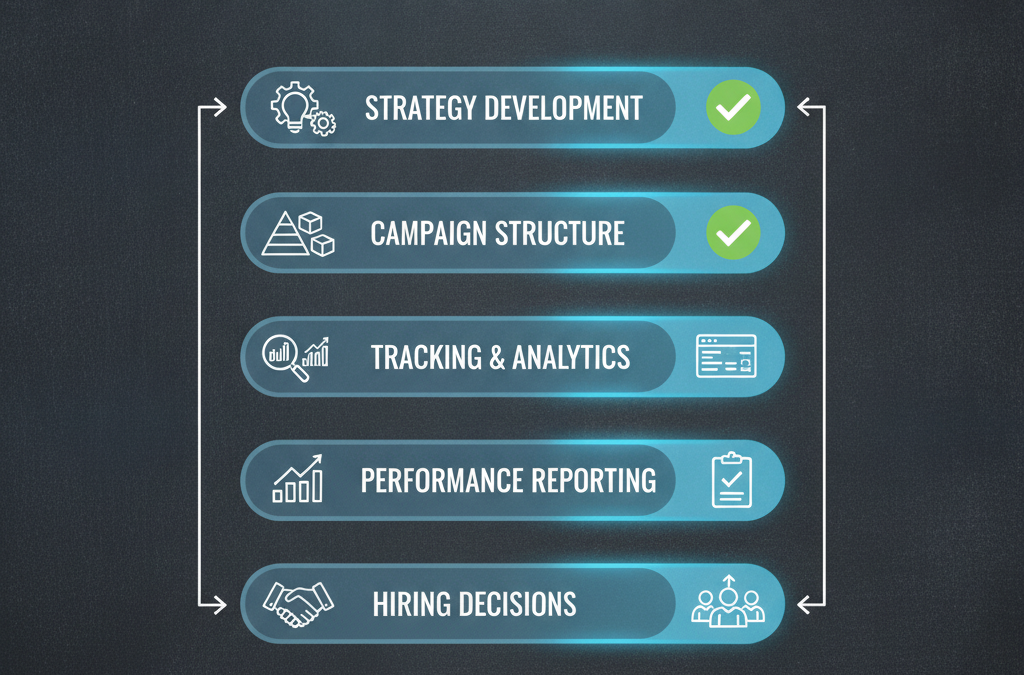
A PPC specialist helps HVAC companies plan, manage, and improve paid search campaigns so advertising spend is tied to real service inquiries, booked calls, quote requests, maintenance plan leads, and other measurable business outcomes. For heating and cooling contractors, PPC is not just about getting clicks; it is about showing up for the right searchers at the right moment with the right service message.
The general role of a PPC specialist includes keyword research, campaign structure, ad testing, negative keywords, bidding, landing page review, and conversion tracking. For a broader marketing explanation of the role, this PPC specialist guidance explains how paid search management connects clicks, tracking, landing pages, and business outcomes.
In the HVAC industry, that work becomes even more specific. A person searching for “emergency furnace repair near me” has a different intent than someone searching for “best heat pump options,” “AC maintenance checklist,” or “commercial rooftop unit service.” A PPC specialist helps separate those searches so your ad budget is not spent treating every click as equally valuable.
Quick Facts: PPC Specialist for HVAC
The practical version for HVAC contractors and service businesses.
- What: A PPC specialist manages paid search campaigns across HVAC keywords, ads, service-area targeting, bids, budgets, landing pages, tracking, and reporting.
- Who: The role is useful for HVAC companies that depend on phone calls, online booking forms, repair inquiries, installation estimates, maintenance plans, or commercial service leads.
- Where: PPC work usually happens inside platforms such as Google Ads, Microsoft Ads, Google Analytics 4, Google Tag Manager, Merchant Center where relevant, and reporting dashboards.
- How: Campaigns are improved through search term reviews, negative keyword lists, ad copy tests, call tracking, location controls, conversion tracking, and landing page feedback.
- Why: Strong PPC management can help HVAC businesses reduce wasted clicks, improve inquiry relevance, and make ad spending easier to evaluate.
Why HVAC Paid Search Needs Specialist Attention
HVAC paid search can be highly intent-driven because many people search when they have an immediate problem: no heat, no cooling, a broken thermostat, a leaking unit, or an aging system that needs replacement. At the same time, not every search is ready to become a service call. Some users are researching costs, comparing brands, looking for DIY advice, searching for jobs, or trying to identify a part.
A PPC specialist helps organize campaigns around those intent differences. Emergency repair searches may need urgent ad copy, call-focused extensions, and tight service-area targeting. Installation or replacement searches may need landing pages that explain estimates, financing options if offered, equipment categories, and trust signals. Maintenance searches may need a different message focused on tune-ups, inspections, or seasonal service.
For HVAC companies comparing paid search with other digital channels, Zigma Internet Marketing connects PPC with broader Digital Marketing Services so campaign data, website structure, SEO planning, and conversion strategy support each other instead of operating in separate silos.
What a PPC Specialist Does for an HVAC Campaign
A PPC specialist manages the mechanics and strategy of pay-per-click advertising. In HVAC, that usually includes building campaigns for services such as furnace repair, air conditioning repair, heat pump installation, ductless systems, boiler service, indoor air quality, maintenance plans, and commercial HVAC support, depending on what the company actually provides.
The work starts before ads go live. A specialist must understand service categories, service areas, seasonal priorities, call handling, business hours, emergency availability, and which jobs are most valuable to the company. A campaign for a contractor that only serves residential customers should not be structured the same way as one that also serves commercial properties.
After launch, the specialist monitors how the account behaves. Are clicks coming from the right cities or neighborhoods? Are people calling during business hours? Are form submissions relevant? Are searches too broad? Are ads sending emergency repair traffic to a generic homepage? These questions matter because HVAC campaigns can generate activity without generating useful opportunities.
How Search Intent Changes Across HVAC Keywords
Search intent is one of the most important reasons to involve a PPC specialist. HVAC keywords may look similar on the surface, but they often represent different stages of the customer journey.
- Emergency intent: Searches such as “AC repair near me” or “furnace not working” may indicate a need for fast help.
- Replacement intent: Searches such as “new furnace installation” or “heat pump installer” may involve estimates, equipment decisions, and longer comparison periods.
- Maintenance intent: Searches such as “air conditioner tune up” or “HVAC maintenance service” may be suited to seasonal campaigns.
- Research intent: Searches such as “why is my furnace making noise” may be informational and may not convert immediately.
- Poor-fit intent: Searches involving jobs, courses, manuals, free parts, DIY instructions, or unrelated products may need to be excluded.
A PPC specialist groups these searches carefully so ads, budgets, and landing pages match the searcher’s likely need. This can make reporting clearer because emergency repair clicks, installation estimate clicks, and maintenance clicks are not all blended into one vague campaign.
Turning HVAC Clicks Into Calls, Forms, and Booked Appointments
For many HVAC companies, the most important paid search conversion is a phone call. However, not every call has the same value. A wrong-number call, a supplier inquiry, a job applicant, and a homeowner requesting emergency service should not all be interpreted the same way.
A PPC specialist helps define which actions should count as meaningful conversions. That may include qualified phone calls, online booking requests, estimate forms, contact forms, chat inquiries, or maintenance plan requests. The goal is to measure outcomes that reflect genuine business opportunities, not just easy engagement.
When Zigma Internet Marketing manages Google Ads Management, campaign data can be reviewed alongside tracking, landing pages, and customer acquisition goals rather than treated as a standalone ad account.
HVAC PPC and Local Service Areas
Location targeting is especially important for HVAC companies. A campaign may look successful in Google Ads while quietly spending money outside the areas your technicians can serve efficiently. A PPC specialist reviews service-area settings, location reports, and search terms to help avoid mismatches between ad delivery and operational reality.
For example, a company may want to prioritize nearby neighborhoods for emergency repairs while using a broader service area for installations or planned replacements. Another company may want separate campaigns for residential and commercial services because the customer intent, landing page copy, and call handling process may differ.
Local clarity should also appear in ad copy and landing pages. HVAC users often want to know whether the company serves their area, handles the specific system type, offers the service they need, and can be contacted easily. Paid search works better when that information is easy to confirm after the click.
PPC Specialist vs Platform Automation for HVAC Ads
Advertising platforms now include automated bidding, broad match targeting, asset recommendations, and machine-learning campaign types. These tools can be useful, but they still need accurate tracking, clear goals, and human judgment. Otherwise, automation may optimize toward actions that are easy to generate but not necessarily valuable to the HVAC business.
Manual control, automation, and hybrid PPC management
A) Manual control: A PPC specialist directly manages keywords, match types, bids, ad copy, budget allocation, and exclusions.
- How it works: The specialist makes specific changes based on search terms, call data, form submissions, device performance, service areas, and campaign goals.
- Best fit: Manual control may be useful for campaigns that need tight targeting, limited budgets, niche services, or careful lead quality filtering.
- HVAC example: A contractor may exclude searches for HVAC jobs, DIY repair guides, appliance parts, or services outside the company’s territory.
B) Platform automation: Automated bidding and campaign types use platform signals to adjust delivery at scale.
- How it works: The platform uses conversion data, user signals, device data, audience patterns, and auction conditions to adjust ad delivery.
- Best fit: Automation works better when conversion tracking is accurate, the account has enough useful data, and the campaign goals are clearly defined.
- HVAC example: Automated bidding may be considered after phone calls and qualified form submissions are tracked properly.
C) Hybrid management: A PPC specialist sets the structure, tracking, exclusions, campaign priorities, creative direction, and testing plan while using automation where it supports the goal.
- How it works: The specialist gives the platform better inputs and then reviews whether automated decisions are producing useful HVAC leads.
- Best fit: Hybrid management often fits local service businesses because it combines machine learning with practical business judgment.
- HVAC example: A campaign may use automated bidding while the specialist still controls service categories, negative keywords, call tracking, and location exclusions.
Skills That Matter in HVAC PPC Management
Basic setup can get HVAC ads running. Strong PPC management makes the account easier to diagnose, improve, and connect to business results. The difference often appears in details that are easy to miss when reviewing only clicks, impressions, and cost per click.
A capable PPC specialist should understand how HVAC search behavior changes by urgency, season, location, system type, and service category. They should also understand that a high click volume does not automatically mean strong campaign performance if the calls are unqualified or the landing page does not help visitors take action.
Core Capabilities to Look For
- HVAC keyword segmentation: Repair, installation, maintenance, indoor air quality, and commercial service searches are grouped by intent.
- Negative keyword discipline: Poor-fit searches such as jobs, training, free manuals, parts-only searches, and DIY research terms are reviewed and excluded where appropriate.
- Conversion tracking accuracy: Calls, forms, booking requests, and other actions are measured in a way that reflects real service opportunities.
- Service-area control: Ads are reviewed to ensure they are reaching locations the company actually wants to serve.
- Landing page feedback: The specialist can identify when the page after the click is limiting performance.
- Readable reporting: Reports explain what changed, what was tested, and how the numbers connect to business decisions.
How to Evaluate a PPC Specialist Before Hiring One for HVAC Marketing
Hiring a PPC specialist should involve more than asking whether they know Google Ads. For an HVAC company, the better test is whether they ask about your service mix, service area, call handling, technician capacity, seasonality, lead quality, website experience, and tracking setup before recommending a campaign structure.
Step 1: Ask How HVAC Conversions Will Be Defined
A specialist should clarify which actions count as meaningful conversions. A phone call, quote form, maintenance request, emergency service call, chat interaction, and newsletter signup do not carry the same business value.
What to listen for: A clear separation between high-value service inquiries and softer engagement actions.
Risk if skipped: Campaigns may optimize for easy actions that do not produce real service opportunities.
Step 2: Review How Search Terms Are Handled
Search term reviews show whether ads are attracting the right audience. A PPC specialist should explain how often search terms are reviewed and how negative keywords are added.
What to listen for: Specific references to irrelevant intent, service mismatch, location mismatch, and repeated budget leakage.
Risk if skipped: The same irrelevant HVAC searches can continue spending budget month after month.
Step 3: Ask Whether Landing Pages Are Reviewed
PPC performance is strongly tied to the page after the click. HVAC landing pages should make the service, location, phone number, request path, and trust information easy to understand.
What to listen for: Practical comments about page intent, mobile layout, form friction, call buttons, service details, and message match.
Risk if skipped: Ads may send qualified visitors to pages that do not help them contact the company.
Step 4: Ask How Reports Connect to Decisions
A useful PPC report should not only list impressions, clicks, and cost per click. It should explain what changed, what was learned, and which action will be taken next.
What to listen for: Plain explanations of tests, trade-offs, account changes, lead quality, and service-category performance.
Risk if skipped: Reporting can become a monthly data dump with little connection to campaign improvement.
Step 5: Confirm Account and Data Ownership
Access and ownership should be discussed before campaigns begin. The HVAC company should understand who owns the ad account, analytics setup, tags, landing pages, call tracking, and historical performance data.
What to listen for: Transparent access practices and clear documentation.
Risk if skipped: A business may lose visibility into historical campaign data or advertising assets if a vendor relationship ends.
SEO and PPC for HVAC Work Better When Data Is Shared
SEO and PPC solve different timing problems for HVAC companies. PPC can help test service messages and generate visibility once campaigns are approved. SEO usually builds visibility over time through technical website health, useful content, local relevance, and search authority.
The two channels can inform each other. PPC search terms can reveal which HVAC phrases attract service inquiries, while SEO content can support recurring informational searches that may not justify paid clicks. For example, a high-converting paid search term may deserve a dedicated landing page, while a research-heavy question may be better suited for an educational article.
Zigma Internet Marketing supports this kind of channel coordination through SEO Services, PPC management, content, analytics, and conversion-focused web work.
Common HVAC PPC Mistakes a Specialist Should Catch Early
Many PPC problems are not dramatic. They are small campaign issues that repeat quietly until they waste budget or distort reporting. A specialist should be able to identify these problems early and explain how they affect business decisions.
- Sending every ad to the homepage: Emergency repair, installation, maintenance, and commercial service searches often need different page messages.
- Ignoring service-area limits: Ads may spend in locations that are outside the preferred service area or difficult to serve efficiently.
- Treating every call as equal: Qualified repair calls, sales inquiries, spam calls, and job applicants should not be reported as identical outcomes.
- Using broad targeting without guardrails: Broad match can attract irrelevant searches if negative keywords and conversion data are weak.
- Mixing residential and commercial intent: These audiences may need different keywords, ads, landing pages, and reporting views.
- Judging campaigns only by cost per click: A cheap click is not helpful if it rarely becomes a qualified HVAC inquiry.
- Ignoring sales or dispatch feedback: PPC data becomes more useful when the specialist knows which leads were serious, which were unqualified, and which became booked work.
A useful guiding question is simple: would the campaign still look successful if your office staff or sales team reviewed lead quality instead of only platform conversions?
What Useful HVAC PPC Reporting Should Include
PPC reporting should help an HVAC business understand cause and effect. If spend increased, the report should explain whether the change came from higher seasonal demand, broader targeting, stronger conversion rates, new tests, or increased competition in the ad auction.
Useful reporting separates activity metrics from business metrics. Clicks, impressions, click-through rate, and cost per click show campaign movement. Calls, forms, booked appointments, estimate requests, qualified inquiries, conversion rate, and cost per acquisition help show whether that movement was useful.
A good reporting rhythm also includes interpretation. The PPC specialist should identify which service categories improved, which declined, what was changed, and what will be tested next. Without that explanation, campaign data can look precise while still leaving business owners unsure about what to do.
When an HVAC Company May Not Be Ready for PPC Yet
Not every HVAC company is ready to scale paid search immediately. A campaign needs enough clarity to give a PPC specialist something useful to optimize. If the website is unclear, the call process is inconsistent, the service area is not defined, or tracking is missing, paid ads may expose those gaps quickly.
Before increasing ad spend, an HVAC company may need to improve landing pages, call tracking, service descriptions, contact forms, local pages, or lead response processes. That does not mean PPC is the wrong channel. It means the foundation affects how much useful data paid search can produce.
This is where a full-funnel view helps. Zigma Internet Marketing often looks at PPC alongside Website Design & Development, analytics setup, landing pages, and conversion rate optimization so paid traffic is not sent into a weak customer journey.
Choose a PPC Specialist Who Can Explain the Numbers Clearly
A trustworthy PPC specialist can explain the relationship between HVAC search intent, service-area targeting, budget, conversion tracking, landing pages, and lead quality in plain language. The strongest signal is not a complicated dashboard; it is a clear explanation of what the data suggests and what decision should follow.
For HVAC companies, that clarity matters because paid search is connected to real operational questions: which services should be promoted, where calls are coming from, which campaigns are producing useful inquiries, and whether the website is helping visitors take the next step.
If you want expert help reviewing paid search, analytics, SEO, or landing pages, you can contact Zigma Internet Marketing at (647) 556-6071 or info@zigma.ca.
FAQs About PPC Specialists for HVAC
What does a PPC specialist do for an HVAC company?
A PPC specialist manages paid search campaigns for HVAC services by organizing keywords, ads, budgets, service-area targeting, landing pages, conversion tracking, and reporting. The goal is to connect ad spend to useful calls, forms, estimate requests, and booked appointments.
Why is HVAC PPC different from general paid search?
HVAC PPC often depends on urgency, seasonality, location, service type, and call quality. Emergency repair searches, installation searches, maintenance searches, and commercial service searches may need different campaign structures and landing pages.
Can a PPC specialist improve HVAC lead quality?
Yes. A PPC specialist can improve lead quality by refining keywords, excluding poor-fit searches, adjusting ad copy, improving landing page alignment, tightening service-area targeting, and separating qualified conversions from low-value actions in reporting.
Should HVAC PPC focus on calls or forms?
Many HVAC campaigns prioritize phone calls because urgent service searches often lead to direct contact. However, forms, estimate requests, online bookings, and chat inquiries may also be valuable depending on the company’s sales process and service model.
What should I ask before hiring a PPC specialist?
Ask how conversions will be tracked, how service-area targeting will be managed, how search terms will be reviewed, whether landing pages are assessed, and how reporting will connect to lead quality and business decisions.


